The sound of a perfect falafel isn't just a crunch; it is a structural failure of a highly engineered legume matrix. We are talking about the precise moment where hydration meets thermal shock to create a shatter-zone of golden-brown chickpeas. If your crust feels like damp cardboard or a tooth-breaking pebble, your infrastructure has failed. To achieve the ultimate Falafel Crust Density, we must treat the chickpea not as a vegetable, but as a structural component capable of intense aeration and rapid dehydration. The goal is a delicate, honeycombed exterior that protects a vibrant, herb-infused interior. This is a game of moisture migration and surface area optimization. We are building a fortress of flavor that must withstand the violent convection of 375-degree oil. If you want to move beyond the soggy, leaden pucks of amateur kitchens, you must understand the molecular physics of the pulse. We are here to audit your process, refine your ratios, and ensure that every bite delivers a piquant explosion of texture and spice.
THE DATA MATRIX
| Metric | Specification |
|---|---|
| Prep Time | 24 Hours (Soaking) + 30 Minutes (Mincing) |
| Execution Time | 15 Minutes |
| Yield | 24 Spheres / 6 Servings |
| Complexity (1-10) | 7 |
| Estimated Cost per Serving | $1.45 USD |
THE GATHERS
Ingredient Protocol:
- 500g / 2.5 cups Dried Chickpeas (Never canned)
- 150g / 1.5 cups Fresh Parsley (Flat-leaf)
- 100g / 1 cup Fresh Cilantro
- 60g / 0.5 cup Scallions (White and green parts)
- 4 Large Garlic Cloves (Peeled)
- 15ml / 1 tbsp Lemon Juice
- 10g / 2 tsp Cumin Seeds (Toasted and ground)
- 10g / 2 tsp Coriander Seeds (Toasted and ground)
- 5g / 1 tsp Baking Soda
- 10g / 2 tsp Kosher Salt
- 1000ml / 4 cups Neutral High-Smoke Point Oil (Grapeseed or Peanut)
Section A: Ingredient Quality Audit:
If your dried chickpeas are older than a year, they will refuse to hydrate properly, leading to a gritty, sandy interior regardless of soak time. Audit your pulse supply by checking for a dusty sheen; if they look dull, add an extra pinch of baking soda to the soaking water to help break down the hemicellulose. If your herbs are wilted, they will release excess moisture into the mix, compromising the Falafel Crust Density. To fix this, shock your greens in ice water for ten minutes, then spin them aggressively in a salad spinner until bone-dry. Moisture is the enemy of the structural integrity we are seeking to build.
THE MASTERCLASS
1. The Hydration Phase
Place your dried chickpeas in a large bowl and cover with cold water by at least four inches. Allow them to hydrate for a minimum of 18 to 24 hours at room temperature. Do not use heat to speed this up. The beans should double in size and be tender enough to split with a fingernail but still offer resistance.
Pro Tip: Use a digital scale to measure your water absorption. A 100 percent weight increase indicates optimal saturation. This ensures the starch granules are ready to gelatinize instantly upon hitting the oil.
2. The Fragmentation Process
Drain the chickpeas thoroughly. In a food processor, combine the pulses, herbs, garlic, and spices. Pulse the mixture until it resembles coarse sand or fine bulgur. You are looking for a granular texture, not a paste. If you over-process, you will create a dense, "viscous" mass that won't aerate.
Pro Tip: Use a bench scraper to clear the sides of the processor bowl halfway through. This ensures a uniform particle size, which is critical for consistent Falafel Crust Density across the entire batch.
3. The Aeration and Rest
Transfer the mixture to a stainless steel bowl. Sprinkle the baking soda and salt over the top. Fold the mixture gently to incorporate. Cover and refrigerate for at least 30 minutes. This rest allows the starches to settle and the baking soda to begin creating micro-pockets of carbon dioxide.
Pro Tip: Professional chefs use this resting period to "infuse" the flavors. The cold temperature also firms up the natural proteins, making the shaping process easier without the need for flour or binders.
4. The Structural Formation
Using a falafel scoop or a leveled tablespoon, gently form the mixture into small balls or discs. Do not compress them too tightly. You want the surface to be slightly "craggy" to maximize the surface area for the Maillard reaction.
Pro Tip: Weigh each ball on your digital scale (approximately 25g to 30g). Uniformity in mass ensures that every piece reaches the target internal temperature at the exact same moment.
5. The Thermal Execution
Heat your oil in a deep saucier or heavy-bottomed pot to exactly 375 degrees Fahrenheit. Fry the falafel in small batches to avoid dropping the oil temperature. Fry for 3 to 4 minutes until the exterior is a deep, mahogany brown.
Pro Tip: Use an instant-read thermometer to monitor the oil. If the temperature drops below 350, the oil will penetrate the crust and make the falafel greasy. High heat is required to "render" the exterior into a crisp shell.
Section B: Prep & Timing Fault-Lines:
The most common failure in the infrastructure of a falafel is the "Disintegration Event." This happens when the oil is too cold or the mixture is too wet. If your first test ball falls apart, your Falafel Crust Density is compromised by excess water. Fix this by folding in a teaspoon of chickpea flour to absorb the surplus moisture. If the falafel browns too quickly but remains raw inside, your oil is too hot; the exterior is "sealing" before the heat can conduct to the center.
THE VISUAL SPECTRUM
Section C: Thermal & Visual Troubleshooting:
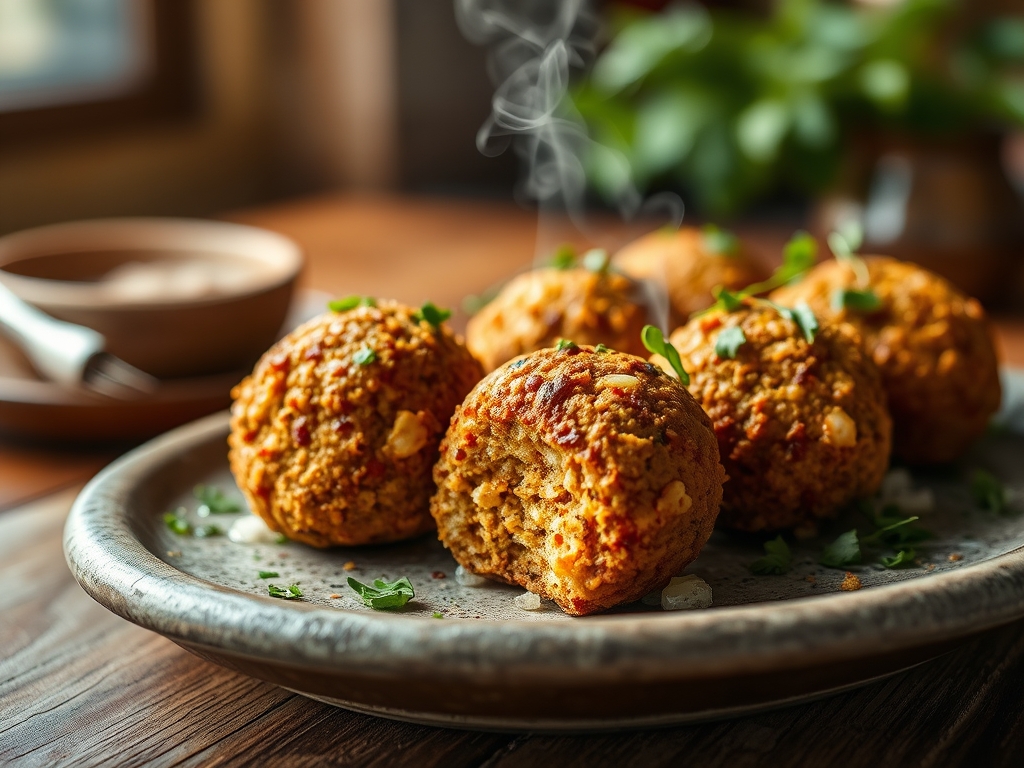
Observe the photo above. Notice the "topography" of the crust. It is not smooth like a hushpuppy; it is irregular and porous. If your falafel looks smooth and pale, you have over-blended the chickpeas into a "viscous" puree. To achieve that specific visual cue of golden-brown crags, ensure your pulse size is roughly 1mm to 2mm. If the color is dull or grayish, your herbs were likely oxidized or wet. Always ensure your oil is clean; old oil will "infuse" a bitter, acrid flavor and result in a dark, muddy appearance rather than the vibrant bronze seen in high-end culinary audits.
THE DEEP DIVE
Macro Nutrition Profile:
A standard serving of four falafel spheres provides approximately 320 calories, 15g of plant-based protein, 12g of fiber, and 18g of healthy fats. The high fiber content from the chickpea skins is what provides the structural framework for the Falafel Crust Density.
Dietary Swaps:
- Vegan: Naturally vegan as specified.
- Keto: Replace chickpeas with a mixture of ground cauliflower and almond flour (Note: This will significantly alter the crust infrastructure).
- GF: Naturally gluten-free; ensure no wheat-based thickeners are added.
Meal Prep & Reheating Science:
To maintain the molecular structure of the crust when reheating, avoid the microwave at all costs. Microwaves vibrate water molecules, which will steam the crust from the inside out, resulting in a rubbery texture. Instead, use an air fryer or toaster oven at 400 degrees Fahrenheit for three minutes. This flashes the exterior oils, re-crisping the shell without drying out the herb-rich core.
THE KITCHEN TABLE
Why is my falafel dry inside?
You likely over-fried them or the oil was too cool, allowing it to soak in and displace the natural moisture. Aim for a fast, high-heat fry to "sear" the exterior while keeping the center vibrant and moist.
Can I use canned chickpeas for this?
Absolutely not. Canned chickpeas are pre-cooked and too soft. They lack the raw starch necessary to create a cohesive Falafel Crust Density. Your falafel will turn into a mushy paste and likely disintegrate in the fryer.
What is the best oil for frying?
Peanut oil is the gold standard due to its high smoke point and neutral profile. If allergies are a concern, grapeseed oil or refined avocado oil are excellent secondary options for maintaining thermal stability during the fry.
How do I get that bright green color?
The secret is a massive volume of fresh herbs and a quick fry time. If the interior is yellow or brown, you have either skimped on the parsley or overcooked the batch. Freshness is the key to a "piquant" interior.